Most lead databases become outdated quickly, and generic AI can sound confident while relying on old information.
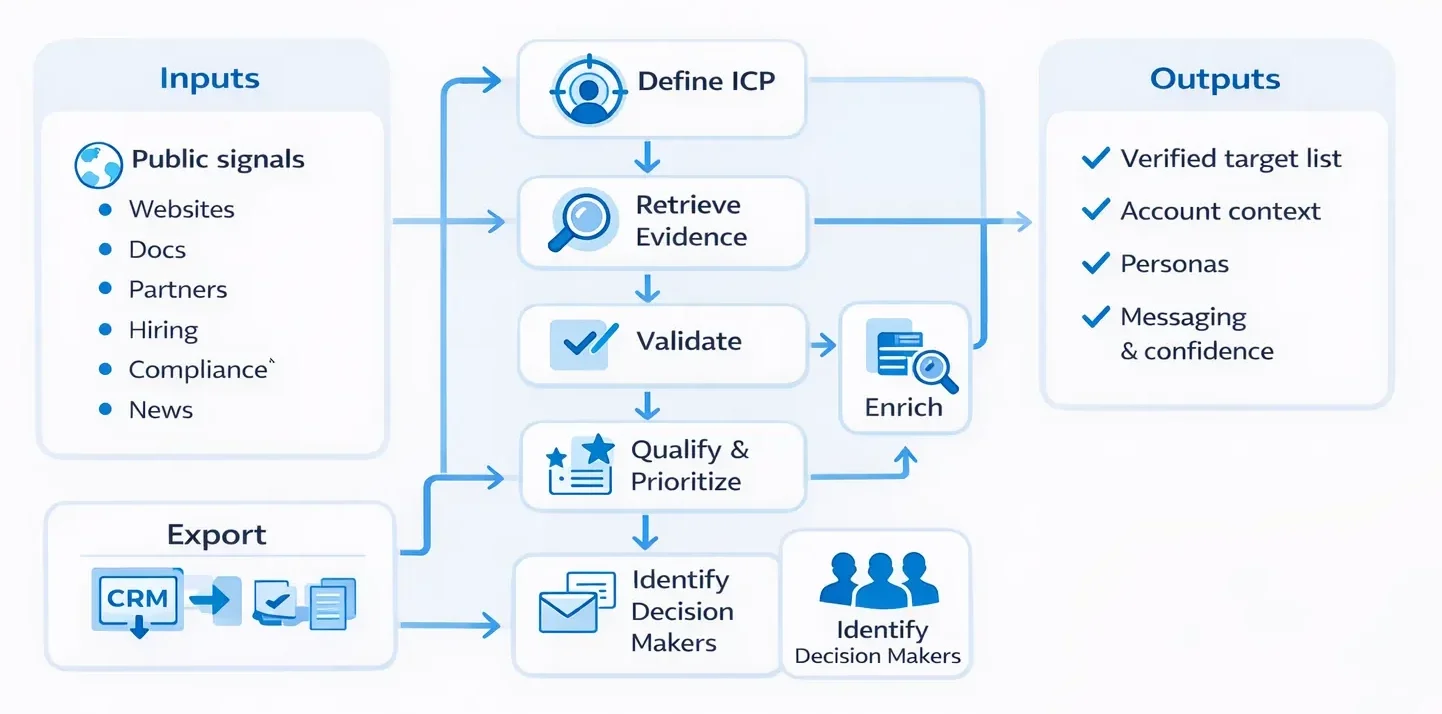
Our approach is grounded in evidence. We first retrieve and validate up to date signals from public sources, then generate insights on top of them. This ensures your targeting and outreach are based on what is true today, not what was true last year.
Grounded RAG Lead Generation Workflow
Technology and IT changes quickly. New products ship often, integrations evolve, and the people you sell to move roles fast. That pace makes static lead databases unreliable and makes ungrounded AI summaries easy to get wrong. A grounded retrieval first RAG approach fits this industry because there is a constant stream of public information that can be verified in real time.
Technology companies publish strong signals across documentation centers, release notes, partner pages, customer stories, security statements, and hiring pages. When you retrieve that evidence first and then generate insights from it, targeting becomes more accurate and outreach becomes more relevant. We help teams identify best fit accounts, find the right stakeholders across IT, security, engineering, and revenue operations, and craft timely outreach angles based on what the company is doing today rather than assumptions from old data.
Automotive and transportation markets move through fast program cycles and complex supplier networks. Product focus, platform commitments, and sourcing priorities can shift quickly, which makes static lead lists unreliable. A grounded retrieval first RAG approach fits well because many of the most important signals are public and can be verified as they change.
We pull evidence from product and platform pages, partner and supplier pages, hiring trends, press releases, certifications, and project announcements. This helps you identify the right accounts across OEMs, tier suppliers, fleet operators, and mobility platforms, then map the stakeholders in engineering, procurement, and operations with outreach angles tied to what is happening now.
Construction and architecture is highly regional and project driven, with many specialized firms that are hard to capture in a single database. Roles and subcontractor relationships change from project to project, and a generic description of a company often misses what they actually deliver. Grounded retrieval first RAG works well because project portfolios and capability proof points are usually visible online.
We use public evidence such as project pages, bid language, compliance and certification references, service area pages, and partner ecosystems. This supports account qualification by trade, region, and project type, and helps you target the right decision makers across owners, developers, architects, general contractors, and facilities teams.
Energy and sustainability buying is shaped by regulation, incentives, and long project timelines. Accuracy matters because the wrong claim can damage credibility quickly. Grounded retrieval first RAG is a strong fit since many signals are published in announcements, partner activity, and public documentation that can be checked and refreshed often.
We retrieve evidence from project updates, technology deployments, regulatory and standards language, partner pages, and procurement signals. This helps you prioritize accounts based on current initiatives, then map stakeholders across engineering, operations, finance, and procurement with messaging that reflects what the organization is actively working on
Manufacturing and industrial markets are fragmented with a long tail of niche capabilities. Many companies look similar in a directory, but their real differentiators live in product catalogs, certifications, and documented processes. Grounded retrieval first RAG fits well because it can validate what a company actually makes and how it positions its capabilities.
We use public evidence from product lines, quality certifications, facility and footprint signals, distributor and partner pages, and case studies. This enables more precise segmentation by capability and supply chain role, and helps you reach the right stakeholders in operations, engineering, quality, maintenance, and sourcing.
Agriculture and farming combines global brands with regional specialists, dealer networks, and seasonal buying cycles. Databases often miss local structure and product focus, and outreach fails when it ignores territory and seasonality. Grounded retrieval first RAG works well because product lines, dealer coverage, and use cases are commonly published and easy to verify.
We retrieve evidence from equipment and product pages, dealer locator pages, service regions, agronomy content, and announcements tied to seasons and crop needs. This helps you build targeted lists by region and segment, then identify decision makers across farm operations, procurement, and technical teams with relevant timing cues.
Medical and healthcare purchasing is high stakes and often regulated, so precision and verification are critical. Generic descriptions create risk, and outdated assumptions can break trust. Grounded retrieval first RAG fits this space because many relevant signals are available in product documentation, quality statements, and publicly available compliance and certification references.
We use evidence from product indications and use cases, quality and safety information, certifications, partner networks, and published clinical or operational outcomes where available. This helps you qualify accounts carefully, then map stakeholders across clinical leadership, IT, procurement, and operations with messaging that stays aligned to verified public facts.
Retail and e commerce organizations change priorities quickly and often publish clear signals about technology, operations, and growth plans. Static lists get outdated fast, and generic AI often misses what stack or operational model a retailer is running. Grounded retrieval first RAG fits well because retailers leave strong public footprints across integrations, hiring, and partner ecosystems.
We retrieve evidence from platform and integration pages, job postings, store footprint updates, partner listings, and customer experience initiatives. This supports segmentation by business model and maturity, and helps you target the right roles across digital, growth, operations, and customer experience teams with timely outreach angles.
Fashion and apparel is shaped by seasons, supply chain shifts, and changing consumer expectations. Many brands and manufacturers publish sustainability, sourcing, and operational signals, but those details change and are often misrepresented in generic summaries. Grounded retrieval first RAG works well because it can continuously verify what a company claims and where it is focusing.
We use evidence from sourcing and sustainability pages, supplier and manufacturing statements, retail footprint changes, partner ecosystems, and product focus signals. This helps you prioritize targets by category and supply chain role, then find the right stakeholders across merchandising, operations, supply chain, and digital commerce.
Electronics and semiconductor markets demand precision. Buyers care about specifications, certifications, design compatibility, and supply continuity, and small inaccuracies can break trust quickly. Static lead data often fails because product lines evolve, acquisitions happen, and manufacturing footprints change. A grounded retrieval first RAG approach fits well because many of the most important signals are published and can be verified.
We retrieve evidence from product catalogs, datasheets, reference designs, qualification and compliance pages, partner ecosystems, and manufacturing or distribution disclosures where available. This helps you identify best fit accounts across device makers, OEMs, design houses, distributors, and contract manufacturers, then target the right stakeholders in engineering, sourcing, and product teams with context that stays accurate.
Telecommunications and networking evolves through deployment cycles, standards, and ecosystem partnerships. The difference between a good lead and a wasted conversation is often whether the account is actively building, upgrading, or integrating right now. Grounded retrieval first RAG is a strong fit because telecom companies publish clear signals across solution briefs, coverage and rollout updates, partner programs, and hiring.
We retrieve evidence from public deployment announcements, solution documentation, partner pages, product and service catalogs, and ecosystem signals. This helps you find best fit accounts across carriers, network equipment providers, integrators, and enterprise connectivity buyers, then map stakeholders across network engineering, operations, IT, and procurement with outreach angles tied to current priorities.
Aerospace and defense is a high compliance environment where accuracy and credibility are essential. Many organizations are hard to profile from generic sources, and careless claims can damage trust immediately. Grounded retrieval first RAG can be a good fit when there is enough public information to validate capabilities, certifications, and program relevance without overreaching.
We retrieve evidence from quality and certification references, supplier registration signals, published capability statements, standards language, and public program information where available. This supports careful account qualification, helps identify relevant suppliers and partners, and maps stakeholders across engineering, program management, supply chain, and procurement using messaging that stays aligned to verifiable facts.